
Published by Drug Driving Solicitors, specialist UK solicitors defending drivers facing drug driving charges.
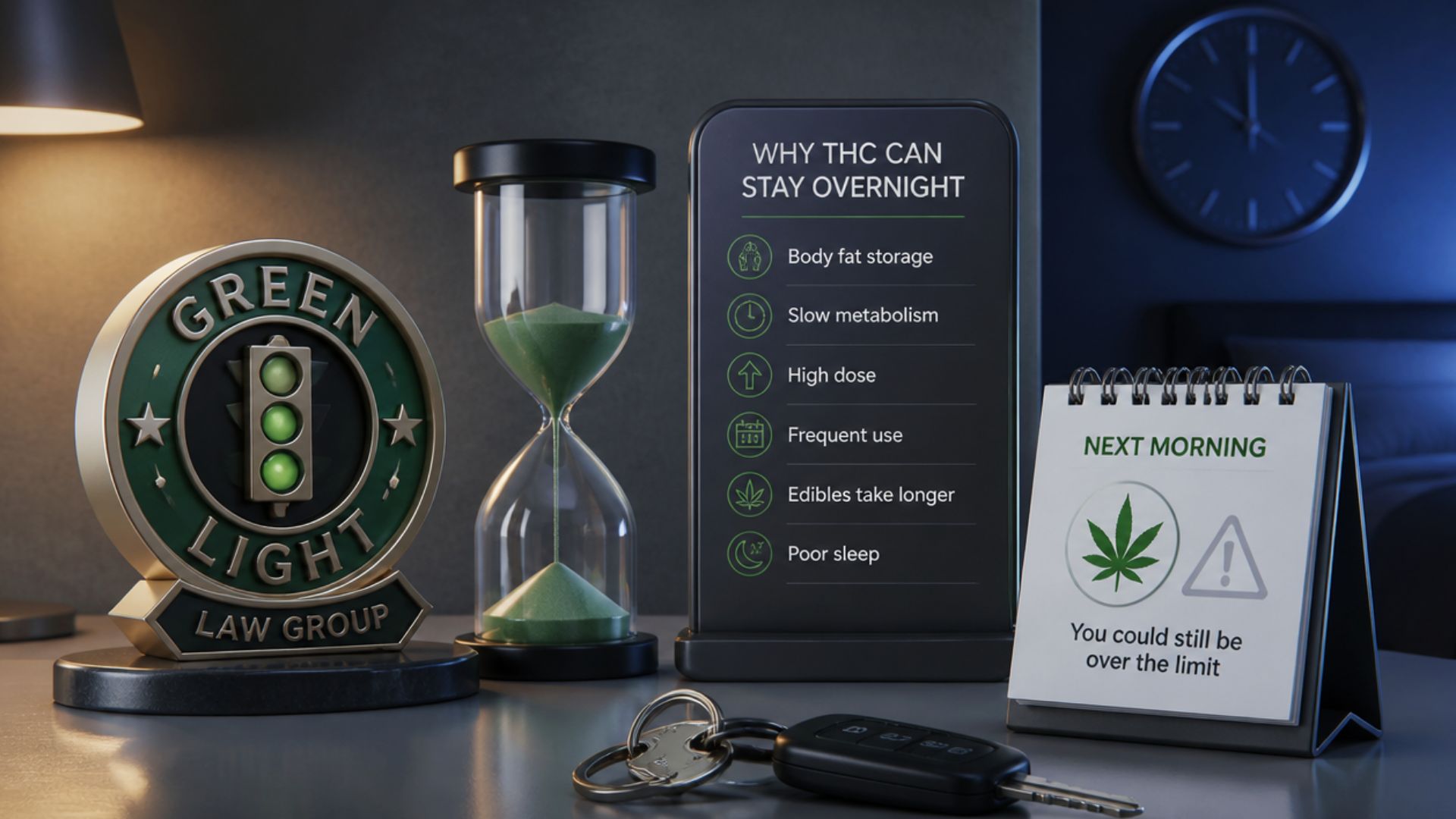
6 Reasons You Could Still Be Over the Cannabis Driving Limit the Next Morning
Feeling completely normal the morning after using cannabis does not necessarily mean your blood THC concentration has fallen below the legal driving threshold. THC behaves differently from alcohol in the body, and factors including frequency of use, method of consumption and individual physiology can make it difficult to predict exactly when a person will fall below the specified limit.
In England, Wales and Scotland, the specified blood limit for delta-9-tetrahydrocannabinol, or THC, is 2 microgrammes per litre of blood. It is a very low threshold, introduced as part of a zero-tolerance approach while allowing a margin intended to exclude accidental exposure. Crucially, an offence can arise from being above the specified limit without the prosecution having to prove that the drug visibly affected your driving. Northern Ireland currently operates differently and does not have the same specified THC limit.
1. Feeling Sober Does Not Tell You Your Blood THC Level
You may wake up feeling alert, rested, and entirely free from the effects you noticed the previous evening. That subjective feeling is useful when deciding whether you feel unwell or impaired, but it cannot tell you the concentration of THC that would appear in an evidential blood test.
Subjective Effects and Blood Levels Are Different Measures
The sensation of being "high" depends on what THC is doing in the brain, personal tolerance, and a range of other factors. Blood THC concentration follows its own pharmacokinetic pattern. Research examining cannabis biomarkers and impairment has found that the relationship between blood THC concentrations, subjective intoxication, and driving-related impairment is considerably less straightforward than the relationship between blood alcohol concentration and alcohol impairment.
This is particularly important for regular cannabis users, who may develop tolerance to some noticeable effects. Someone who feels relatively normal may therefore assume that enough time has passed, even though there is no reliable way to calculate their current blood concentration simply from how they feel.
The Legal Test Looks at Concentration
For a Section 5A specified-limit offence in Great Britain, the central issue is whether the concentration of the specified drug exceeds the legal limit. The law does not require evidence that you were obviously intoxicated or driving erratically before an over-the-limit allegation can be made. GOV.UK expressly notes that driving can be unlawful when specified illegal drugs are present above the relevant level even if they have not affected the person's driving.
That is why "I felt fine the next morning" and "my THC concentration was below the specified limit" are not interchangeable statements. Only evidential testing can establish the blood concentration relied upon in a prosecution.
2. Edibles and Other Methods Can Change the Timeline
Cannabis does not enter and leave the body according to one universal schedule. Smoking, vaping, and consuming THC orally produce different absorption patterns, which can make simple estimates such as "I stopped at midnight, so I must be fine by breakfast" unreliable.
Edibles Usually Have a Slower Course
When cannabis is inhaled, THC reaches the bloodstream rapidly. Oral cannabis behaves differently because it must pass through the digestive system and undergo significant first-pass metabolism in the liver. Controlled studies have found that the effects of edible cannabis can take considerably longer to develop, with peak subjective effects occurring later than with inhaled cannabis.
That delayed pattern can also make the overall timeline harder to judge. Someone consuming an edible late in the evening may still be absorbing and metabolising cannabinoids well after an equivalent inhaled dose would have reached its initial peak.
Route of Administration Matters
Dose, product strength, food intake and the exact formulation can all influence oral THC pharmacokinetics. Studies of edible products have found substantial variation between individuals, which makes a fixed number of hours particularly difficult to rely upon.
The practical point is not that every edible automatically leaves someone over the driving limit the following morning. It is that the method of consumption changes the timing, so a waiting period based on somebody else's experience with smoked or vaporised cannabis may have little relevance to your own blood THC concentration.
3. Frequent Cannabis Use Can Produce Much Longer Detection Windows
Frequency of use is one of the most important reasons two people can consume cannabis at similar times and receive very different blood test results the following day. Occasional use and repeated heavy use can produce very different cannabinoid profiles.
Regular Use Can Create a Residual THC Burden
Research involving frequent, long-term cannabis users has detected THC in blood for considerably longer periods than many people might expect. In one controlled abstinence study, some chronic users continued to have measurable THC several days after stopping cannabis entirely.
Another study of chronic frequent users found extended detection of cannabinoids following repeated consumption, demonstrating that previous patterns of use can influence what remains measurable after the immediate effects of the last dose have passed.
Last Night's Dose Is Not Always the Whole Story
For a regular user, the relevant blood concentration the next morning may therefore reflect more than one isolated evening of cannabis use. Repeated exposure can lead to accumulation and a substantially different elimination pattern from that seen in an infrequent user.
This helps explain why informal rules such as "sleep for eight hours" or "leave it until the morning" are unreliable. One person may fall rapidly below a particular concentration, while another with a history of frequent use may retain measurable THC for much longer.
4. The THC Limit Is Deliberately Very Low
One of the biggest misconceptions about cannabis driving law is that the specified limit represents a concentration at which someone must be seriously intoxicated. That is not how the threshold was designed.
It Is Not an Impairment Threshold
The specified THC limit in England and Wales is 2 µg/L of blood, with Scotland using the same numerical limit. Government policy describes cannabis as belonging to a group for which a zero-tolerance approach was adopted. However, the figure was deliberately set above zero to provide tolerance for accidental exposure.
The Crown Prosecution Service similarly stresses that the offence should not be described as literally zero tolerance because the statutory figures include that small allowance. The important point for drivers is that the THC threshold is not intended to represent a level of severe impairment.
Section 5A Focuses on the Specified Concentration
Section 5A created an offence based on having a specified controlled drug above its statutory limit while driving, attempting to drive or being in charge of a motor vehicle. That is separate from the older Section 4 offence concerning driving while unfit through drugs.
As a result, a driver does not necessarily escape a Section 5A allegation simply because there was no weaving, speeding, collision or other obvious sign of impairment. A blood result above the applicable threshold can itself form the basis of the specified-limit charge.
5. THC Is Stored and Released Differently From Alcohol
People often approach cannabis using the same mental model they use for alcohol. They assume that once several hours have passed, the substance should simply work its way steadily out of the bloodstream. THC does not behave that neatly.
THC Is Highly Fat-Soluble
THC is strongly lipid-soluble, meaning it distributes into fatty tissues after entering the body. Scientific reviews describe THC accumulating in adipose tissue and subsequently being released back into circulation over time.
This contributes to the complicated elimination pattern seen after cannabis use, particularly with repeated exposure. Blood concentrations can fall sharply after the initial peak, but that does not mean every trace of THC has simply disappeared from the body.
Clearance Is Not a Simple Hourly Countdown
Alcohol is often discussed using approximate rates of elimination, although even alcohol calculations should be treated cautiously. Cannabis is considerably less suited to that type of countdown because its absorption, distribution and redistribution depend on numerous variables.
There is consequently no responsible formula such as "one joint equals X hours before driving". UK government guidance itself says it cannot provide dose-based guidance showing when someone will be below the specified drug limits because physical characteristics and other variables produce too much individual variation.
6. Your Individual Physiology Changes the Picture
Even if two people use the same cannabis product at the same time, they should not assume that they will produce identical blood results the next morning. Cannabis pharmacokinetics vary significantly between individuals.
Metabolism and Body Composition Can Differ
THC is metabolised principally in the liver and distributed widely throughout the body, including into fatty tissue. Differences in metabolism, body composition, previous exposure, dose and other physiological factors can therefore influence how THC is processed and redistributed.
This does not mean that body weight can be plugged into a simple THC calculator. Research has not established a dependable body-weight formula for predicting when a particular driver will fall below 2 µg/L, and individual variation remains substantial.
Hydration Is Not a Reliable Shortcut
Food and drink can form part of the variables affecting drug concentrations and absorption, particularly with oral cannabis, but trying to "flush out" THC by drinking large quantities of water is not a scientifically reliable way to guarantee that blood THC has dropped below the driving limit. The underlying metabolism and redistribution of THC cannot be reduced to a hydration trick.
That unpredictability is precisely why comparisons with friends, online calculators or personal experience from a previous occasion can be misleading. What happened after one dose on one day does not prove what an evidential blood sample will show after another.
Why the Morning After Can Still Carry Legal Risk
The central problem with next-morning cannabis driving is uncertainty. Feeling sober, sleeping for several hours or following a waiting period that worked previously does not establish your blood THC concentration. Because the specified limit in Great Britain is very low and THC pharmacokinetics vary substantially according to frequency of use, consumption method and individual physiology, drivers should not assume that the disappearance of noticeable effects means the legal risk has disappeared as well.
Frequently Asked Questions About Cannabis and Drug Driving
Does a Positive Roadside Cannabis Swab Mean I Will Automatically Be Charged?
No. A roadside saliva test is a preliminary screening test rather than the evidential measurement used to determine the precise THC concentration for a Section 5A prosecution. A positive result can provide grounds for arrest and further testing, after which an evidential specimen, normally blood in a drug-driving investigation, is analysed by an accredited forensic laboratory.
The blood result and the procedures surrounding the collection, storage, transportation and analysis of the specimen can therefore be important. A positive roadside swab by itself is not a conviction, and specialist advice may be appropriate where there are questions about the procedure or evidential result.
Is There a Reliable Number of Hours to Wait Before Driving After Cannabis?
No official waiting period guarantees that every driver will be below the cannabis limit. THC clearance varies according to the amount taken, previous cannabis use, the method of consumption, and individual pharmacokinetics. The UK government specifically states that it cannot provide dosage guidance corresponding to the statutory limits because there are too many variables between people.
This makes cannabis different from the rough alcohol calculations people sometimes use. Even then, calculations should never be treated as proof of legal fitness to drive. A laboratory blood analysis is the means by which an actual THC concentration can be established with evidential precision.
Can I Be Charged Even If I Was Driving Normally?
Yes. Section 5A is a specified-limit offence, so the prosecution does not need to establish careless or dangerous driving simply to prove that particular offence. A driver can therefore face an allegation even where their driving itself did not appear erratic.
However, police powers to require preliminary testing are not unlimited. Under Section 6 of the Road Traffic Act 1988, relevant grounds include reasonable suspicion that a driver has alcohol or a drug in their body, suspicion that a moving traffic offence has been committed, or involvement in an accident. A moving traffic offence can therefore create testing powers without separate evidence of impaired driving.
How Long Can Cannabis Remain Detectable in Blood?
There is no single detection period that applies to everyone, and the answer also depends on the sensitivity and cut-off of the laboratory method being discussed. Following occasional use, measurable blood THC may decline substantially within hours, while studies of frequent users have demonstrated detectable THC for several days after cannabis use stops.
Detection should also not be confused automatically with being above the UK driving threshold. A laboratory may be capable of detecting concentrations below 2 µg/L. The legally relevant question in a specified-limit case is the concentration established for the evidential specimen and how that result relates to the applicable statutory limit.
What Should I Do If I Am Charged After Using Cannabis the Night Before?
Seek specialist legal advice as early as possible. The timing and method of consumption, frequency of cannabis use, roadside procedure, evidential blood collection and laboratory result may all be relevant when assessing exactly what the prosecution evidence establishes.
Avoid assuming that a next-morning charge must be straightforward simply because you acknowledge using cannabis the night before. Equally, feeling sober is not in itself a defence to an allegation that your blood concentration exceeded the specified limit. A solicitor experienced in drug-driving cases can review the particular evidence rather than relying on general assumptions.
Does It Matter If the Cannabis Was Used Medically or Obtained Legally Abroad?
Recreational cannabis use abroad does not create an exemption from British drug-driving law once you drive in Great Britain. The fact that the substance was obtained legally in another country does not by itself provide a defence to driving above the applicable THC limit.
There is, however, a statutory medical defence under Section 5A for qualifying controlled drugs that have been lawfully prescribed or supplied for medical or dental purposes and taken in accordance with the appropriate medical or manufacturer instructions. The precise requirements matter, and the defence does not permit someone to drive while actually impaired. Informal self-medication or recreational cannabis obtained abroad does not automatically qualify.
Drug Driving Solicitors focus on defending motorists facing drug-driving allegations throughout the UK. If you have been charged following a cannabis test above the applicable limit, contact us for a free and confidential initial consultation about your case.